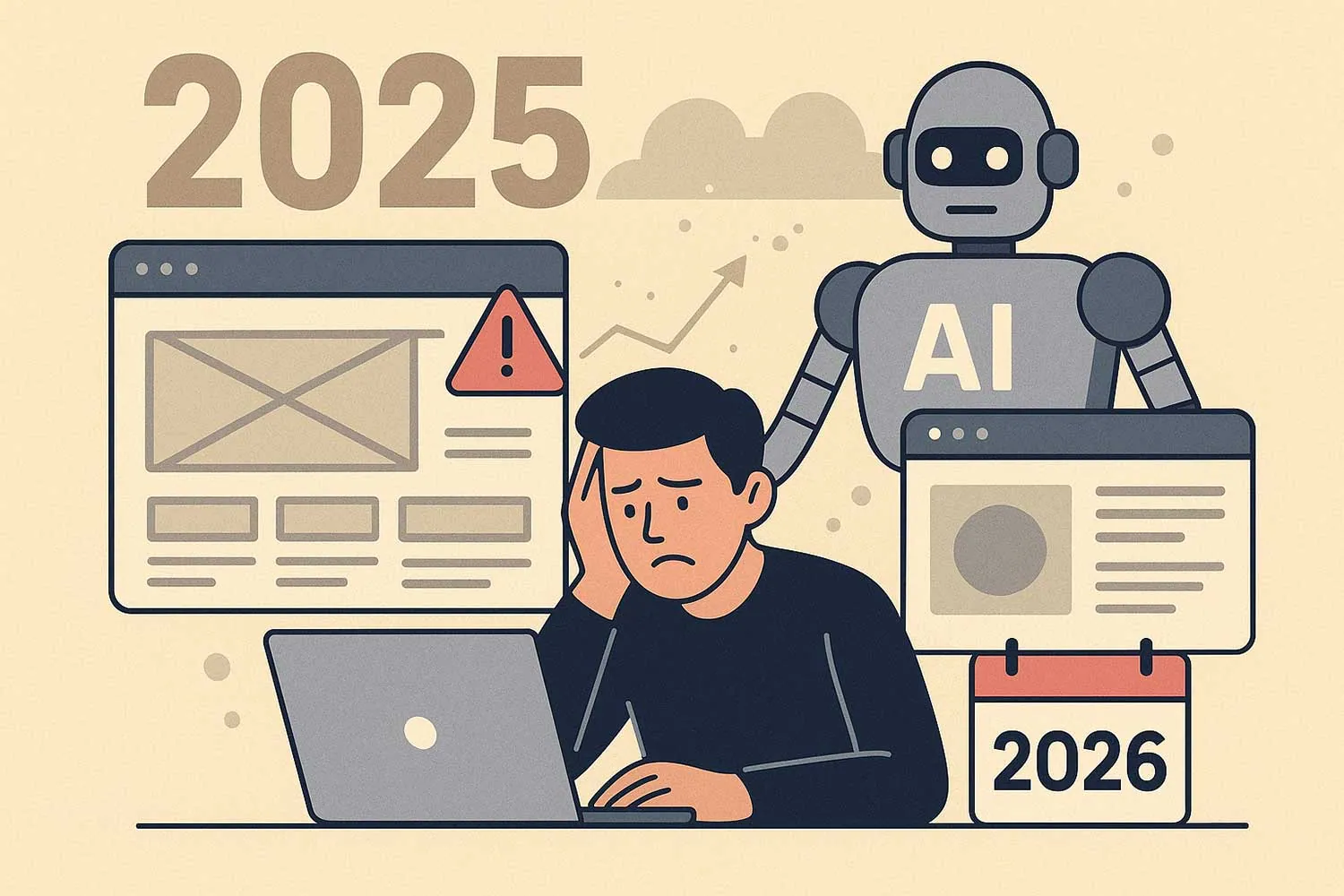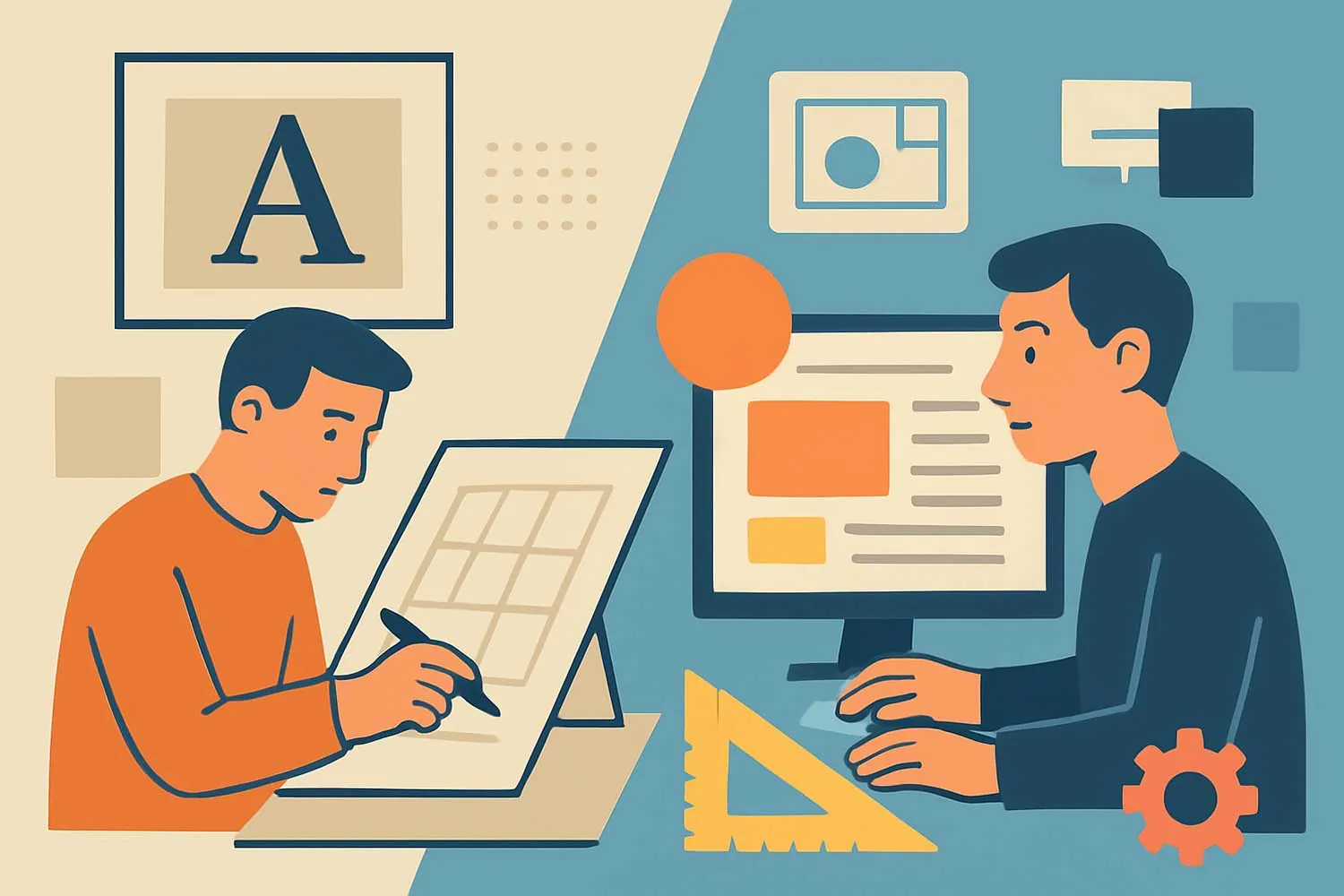
Web design still clings to the roots of traditional graphic design (grids, type hierarchy, perfect symmetry) as if the online world were a magazine page. But in the age of artificial intelligence, those things can be a burden rather than an asset.
The Web Was Never Meant to Be Print
Here is a secret few admit: the web was never designed to be print. Websites are fluid, changeable and interactive, not static like a poster or a magazine page. Yet somehow we keep making mockups in Photoshop as if we were designing a magazine cover. We export pixel-perfect images that break the moment the browser window is resized. We still revere the Swiss grid, as if a 1960s manifesto could explain dropdown menus or responsive breakpoints.
Now AI has ripped off the mask. AI doesn't design posters; it designs outcomes. It creates variations in real time, adapts to context and produces options far faster than we can open Figma. The "print" mindset now feels not just outdated but harmful.
Roots That Entangle
Roots can steady you, but they can also trap you. Graphic design roots give discipline, true. But they also train us to chase absolute control: precise kerning, perfect symmetry, proportions that never shift. That works for a poster on a wall, but it becomes a disaster when an interface has to run on phones, tablets, smartwatches and AI interfaces we may not yet imagine.
With AI, that kind of control is hard to keep. Layouts can be generated dynamically, type systems can shift with user preferences and colours can be chosen algorithmically. The obsession with perfection, inherited from graphic design, makes us fragile.
Sadly, many design schools still teach the grid as the only way. At many agencies, a portfolio is judged by whether a site "could be a billboard". It is like teaching people to ride a horse when what they will actually drive is an electric car. Nostalgic and fun, but is it really useful?
AI Doesn't Care About Heritage
Here is the cold reality: AI doesn't care about aesthetic heritage. It doesn't care that Massimo Vignelli once designed a legendary subway map. It doesn't revere Saul Bass and his classic film titles. Algorithms aren't sentimental; they value results.
Graphic design is often about prestige, visual purity and aesthetic tradition. AI speaks in metrics: clicks, conversions, retention, accessibility scores. What it values is usefulness and performance, not "pure beauty" unless that beauty correlates with results.
If we still cling to those graphic roots, we may already be heading the wrong way. The future of design isn't perfect posters but adaptive systems that change and evolve alongside machines.
Web Design as a Discipline of Its Own
The good news: web design no longer needs to depend on graphic design. The web is not a branch of print but a discipline in its own right, and the AI era forces us to admit it.
The core values of web design need to change:
- Context matters more than fixed composition: one layout can flex depending on the device or user behaviour.
- Adaptability is worth more than visual purity: visual perfection is useless if the design doesn't work in the real world.
- Systems matter more than one-off artefacts: reusable patterns are more useful than one beautiful static screen.
- Performance means more than nostalgia: if design doesn't serve its purpose (users, accessibility, interaction), aesthetics are just decoration.
This doesn't mean abandoning aesthetics. But "beauty" has to be redefined for a world that is fluid, generative and user-led.
An Emotional Farewell
Letting go of those roots isn't easy. It feels like betraying the figures we admire: Vignelli, Bass, the Swiss grid, Helvetica. We grew up revering them. But respect doesn't mean attachment.
Right now many designers are stuck in nostalgia. We idolise grids, Bauhaus design and "pure" simplicity, yet the web has changed. It is as if we were trying to drive a Formula 1 car with the logic of a horse-drawn carriage: a beautiful heritage, but the wrong tools.
Graphic design roots will stay in our DNA. They give us a foundation. But DNA can evolve. Roots can nourish, or entangle. If web design doesn't dare to let go, it may become a heritage craft in the AI era: romantic, but irrelevant.
An Independent Future
So what does a free future look like? Here is how I picture it:
- Designers who aren't afraid of imperfection, because they know AI will produce dozens of versions.
- Design systems that adapt automatically, rather than layouts arranged by hand.
- A focus on real outcomes (user experience, accessibility and interaction), not just static visuals.
Web design is finally standing on its own two feet. For a long time we relied on those roots for legitimacy. Now it is time to form a new identity, perhaps messier, but more authentic to the nature of the web itself.
Graphic design was a beautiful beginning. But it isn't the future. The future belongs to designers who dare to let go, collaborate with AI and stop pretending their job is simply making digital posters.